
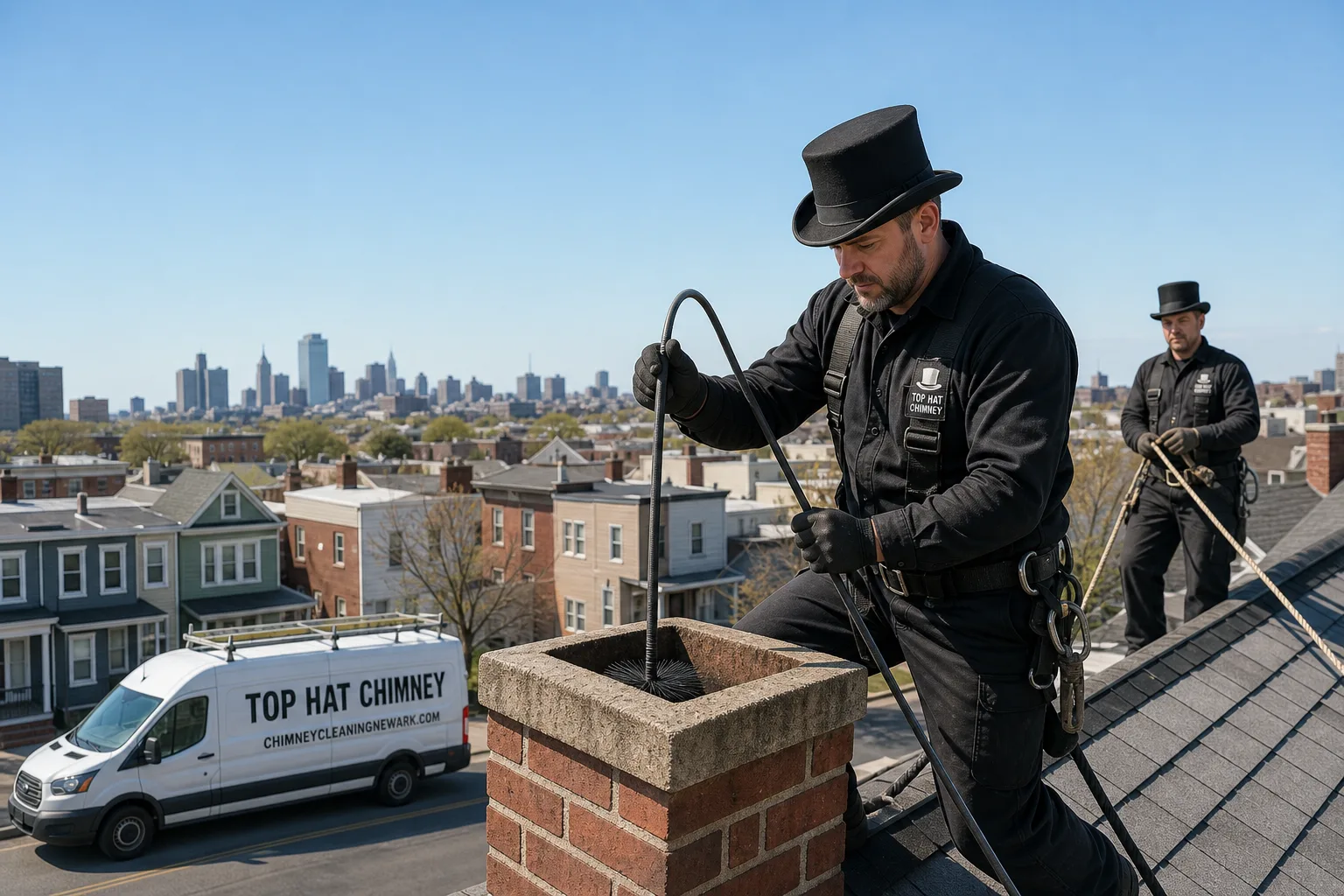
Level 1 sweep and inspection to the NFPA 211 annual standard - flue, crown, cap, and flashing checked and photographed
Chimney sweep logs do not sweep chimneys. They loosen some creosote - which then falls where a brush and vacuum still have to collect it.


 Before
 After
After Before
 After
After Before
 After
AfterFast, Reliable Chimney Cleaning & Sweep Across Kearny
A standard chimney sweep and Level 1 inspection in Kearny runs about $189 to $289, and a Level 2 inspection for a two-family row home with shared flues typically lands between $349 and $499. Most sweeps in town take 60 to 90 minutes once we’re on the roof, and you’ll get camera footage of your flue before we pack up. This is the town where a century-old brick stack serves two households at once, so the stakes are higher than a simple dust-and-go. Call (848) 331-2638 and Wendell or someone from the crew will talk you through what you actually need, not what a franchise script says to sell.
Why Top Hat Chimney Is Kearny’s Preferred Chimney Cleaning & Sweep Company
We’ve worked the row homes between Kearny Avenue, Belgrove Drive, and the numbered side streets long enough to know what lives inside those shared stacks. Ask anyone on your street. This is not a franchise that rotated in last spring. Top Hat Chimney has been at this since 1999, and the sweep who shows up at your door is the same person whose name is on the work. We publish our license number. We answer the phone. And when we finish a sweep in a two-family off Devon Street, we knock on the neighbor’s door if their flue shares the stack, because that’s the kind of thing that matters here.
We’re not the cheapest in town, and we’ll tell you that plainly. What you get is a background-checked, uniformed sweep who gives you a real arrival window and calls if it slips. You get the price before a tool comes off the truck, and that number does not change. You get a 90-Day Done Right Promise in writing on every job. If it’s not right, one call brings Wendell back. No argument, no re-quote.
For Kearny specifically, we know the attached two-family configuration better than most outfits in Hudson County. That means we flag things others miss: a shared flue serving two oil boilers, a crown cracked by Meadowlands wind, a terra-cotta liner crumbling from a coal-to-oil conversion done in the Nixon era. When we write you a report, it reads like a neighbor explaining things on the stoop, not a corporate PDF.
Our Chimney Cleaning & Sweep Services in Kearny
Level 1 Inspection
A Level 1 is the standard once-a-year look: accessible portions of the flue, the firebox, the damper, the cap, the exterior masonry. We run a camera up the flue and show you the footage before we leave. In Kearny, where two-family stacks often share flues, we document each flue separately, because the unit on the left is not responsible for what the unit on the right has been burning. A Level 1 runs $189 to $289, and it’s included with every annual sweep.

Level 2 Inspection
A Level 2 goes further and is the one we push hardest for Kearny two-family owners. It’s required when you’re buying or selling a home, after a chimney fire, after a structural event like a severe storm, or when you’ve changed fuel type, which most of these coal-to-oil conversions did decades ago and never documented. We inspect the attic and crawl spaces, scan the interior with a video camera, and check the flue clearances. In a shared stack off Chestnut Street, that means verifying both flues draft independently and neither one leaks into the other. The liability question alone is worth the $349 to $499.

Creosote Removal
First-degree creosote is a brush job. Third-degree is a glaze, catch it early. In Kearny’s twin-flue stacks, we regularly find one flue with light residue and the other glazed hard from years of low, smoldering oil-burner fires. A rotary whip handles the glaze. Chemicals alone won’t. If you’ve got a unit that burns oil in a flue originally built for coal, you should expect a heavier creosote load, and you should not wait two years between cleanings. Creosote removal generally runs $250 to $450 depending on severity, and we’ll show you the before and after on camera.

Soot Removal
Oil boilers produce a fine, sulfurous soot that coats flue walls and mixes with moisture from the Meadowlands to form an acidic paste. That paste eats terra-cotta liners. In Kearny, where most homes run oil heat through original clay flues, annual soot removal is not a recommendation. It’s the difference between a liner that lasts another decade and one that fails in three. A soot-only sweep runs $150 to $220.

What happens when you call
- 1
A real person answersNo phone trees - you reach a local pro.
- 2
You get an upfront price rangeHonest numbers before anyone is dispatched.
- 3
A background-checked tech heads outLicensed & insured, dispatched right away.
- 4
You approve before work beginsNothing starts until you say go.
Trusted Brands We Service in Kearny
We install and service equipment from brands that hold up in wet, wind-exposed environments: DuraFlex venting for oil-to-gas conversions, Copperfield caps and dampers, and HeatShield resurfacing systems for cracked flues. When a Kearny two-family needs a liner repair, we can often do it with HeatShield instead of a full teardown, which saves you thousands and keeps both households running. We keep common parts on the trucks, so a displaced Copperfield cap can usually be replaced the same visit, not ordered in from a warehouse in Ohio. For our full Chimney Cleaning & Sweep service breakdown, see the hub page.
Common Chimney Cleaning & Sweep Problems We See in Kearny Homes
- Shared flues between two units: One household’s neglect becomes the neighbor’s carbon monoxide problem. We document each flue separately on every inspection and tell you plainly if the other side needs attention.
- Cracked crowns from wind-driven rain: Storms off the Meadowlands push water through spalled crown mortar and into both flues at once. That’s how you get a ceiling stain in the adjoining unit without ever lighting a fire.
- Missing or displaced caps after a Nor’easter: A cap blown off a shared stack lets raccoons and squirrels nest in the flue, blocking draft and pushing exhaust back into the house. We see this every spring in the streets around Kearny Avenue.
- Freeze-thaw spalling at the flashing line: Exposed south-facing chimneys on brick row homes take the worst of it. Water gets behind the flashing, runs down the interior brick, and shows up as a brown stain on the top-floor ceiling.
Pricing for Chimney Cleaning & Sweep in Kearny, NJ
Here’s what we charge in Kearny, no call-center games. A standard sweep with Level 1 inspection is $189 to $289 for a single-flue chimney. Add a second flue for a two-family stack and you’re at $289 to $389. A Level 2 inspection runs $349 to $499. Creosote glaze removal with a rotary whip is $250 to $450. Soot removal from an oil-burner flue is $150 to $220. Repointing a spalled crown or resetting a displaced cap starts at $200 and goes up from there depending on access.
What changes the price: roof pitch and access, severity of creosote, whether we need to remove a pest nest, and whether both flues in a shared stack need work. We tell you the number before we start, and it’s the number on the invoice. If you’ve got a written estimate from another company, bring it. We’ll do a free second opinion, and if you book a repair over $200, you get $40 off. Seniors and veterans always get 10% off. Call (848) 331-2638 for an exact number. Estimates are free.
What Top Hat Chimney Actually Sees in Kearny’s Century-Old Stacks
Kearny’s housing stock is overwhelmingly early-20th-century two-family brick row homes built to house workers from the Clark Thread Mill and other industrial employers. Most have multi-flue chimneys originally designed for coal that were later retrofit for oil heat. Those 60-to-80-year-old conversions commonly left undersized, unlined, or cracked terra-cotta flues still venting active oil boilers, a condition that concentrates sulfurous deposits and accelerates liner failure in ways chimney techs in newer suburban Hudson County towns rarely encounter at the same scale.
And here’s the thing that’s unique to Kearny: because a single chimney stack often contains flues serving oil boilers for two separate households on different ownership or rental agreements, one unit neglecting cleaning can deposit blockages or animal debris that backs carbon monoxide into the neighboring unit. That’s not a theoretical risk. We flag it on every inspection report. It’s a liability dynamic we learned to document carefully, because when something goes wrong in a shared stack, the question of who failed to clean their flue comes up fast.
On a two-family row home off Kearny Avenue, we found the shared chimney stack had a cracked terra-cotta flue liner from an old coal-to-oil conversion, with a crown so spalled that wind-driven rain from the Meadowlands had saturated the mortar bed. Our techs removed third-degree creosote glaze with a rotary whip, installed a HeatShield resurfacing system, and replaced the displaced cap, then verified draft in both units before the first fire of the season. That’s the kind of job we show up for in Kearny, and it’s why we don’t rush a sweep here.
Storm Exposure Around Kearny: What to Check Before the First Fire
Kearny sits on a peninsula between the Passaic and Hackensack Rivers, directly adjacent to the New Jersey Meadowlands. That geography creates persistently elevated ambient moisture. It also means storms hit your chimney harder here than they do five miles inland. Wind-driven rain blows into cracked crowns and open flues. Nor’easters rip caps off shared stacks. Freeze-thaw cycles at the flashing line open gaps that let water run down interior brick all winter.
Before you light the first fire of the season in a Kearny two-family, check three things. First, look at the crown from the street or a neighbor’s window. If the mortar is spalled or missing in chunks, water is getting in. Second, check the cap. A displaced or missing cap is a raccoon invitation, and a nest in a shared flue is a carbon monoxide risk for both units. Third, look for brown stains on the top-floor ceiling near the chimney wall. That’s flashing failure, and it means water has already found a path inside. If you see any of these, call us. We’ll inspect it properly and tell you what actually needs fixing, not what a sales script tells us to sell.
We Also Serve Cities Near Kearny
If you’re in a neighboring town, we cover it too. Our Chimney Cleaning & Sweep in Kearny crew regularly works in East Orange, Newark, Irvington, and West Orange, and we know the housing stock and chimney conditions in each. Call (848) 331-2638 and we’ll tell you straight whether it makes sense for us to come out.
Serving Kearny, NJ - Our Local Coverage Area
We’re based in the Kearny area and know this community well. Use the map below to see our service coverage - if you’re nearby, we can almost certainly help.
FAQs - Chimney Cleaning & Sweep in Kearny
Every two years at minimum, and every year if either unit runs an oil boiler through an original terra-cotta flue. Shared stacks complicate things: a crack in one flue can leak into the other, and nobody knows until a carbon monoxide detector goes off or a buyer’s inspector flags it. Call (848) 331-2638 for an exact quote.
Yes. A cracked crown lets water into both flues whether you burn or not, and in Kearny’s attached row homes that water shows up as a ceiling stain in the adjoining unit. Once a year, burn or no burn. Chimneys break in the off-season too. Call (848) 331-2638 and we’ll take a look.
No. Third-degree creosote is a hardened glaze that standard wire brushes glide over. It takes a rotary whip with chains, and in Kearny’s oil-burner flues we see glaze often enough that we bring the rotary head on every two-family job. Call (848) 331-2638 to schedule a sweep.
Look for a brown or tan water stain on the top-floor ceiling near the chimney wall, or peeling paint on the interior brick if the chimney runs through a closet. Outside, look for gaps where the flashing meets the brick, especially on the south-facing side. If you see any of these, call (848) 331-2638 and we’ll inspect it before the freeze-thaw cycle makes it worse.
It’s shared responsibility, and we document it that way. If their flue has a nest or heavy creosote, your unit’s draft can suffer, and if carbon monoxide backs up, both households are at risk. We note the condition of each flue separately on every inspection report, so there’s a written record of who knew what and when. If you’re concerned, call (848) 331-2638 and we’ll walk through what the camera shows.
Written by Wendell Pike, Owner at Top Hat Chimney, serving Kearny and the surrounding Hudson County communities since 1999. Wendell has spent nearly three decades inside more chimneys than he can count, and he’ll tell you when the job does not need doing.