
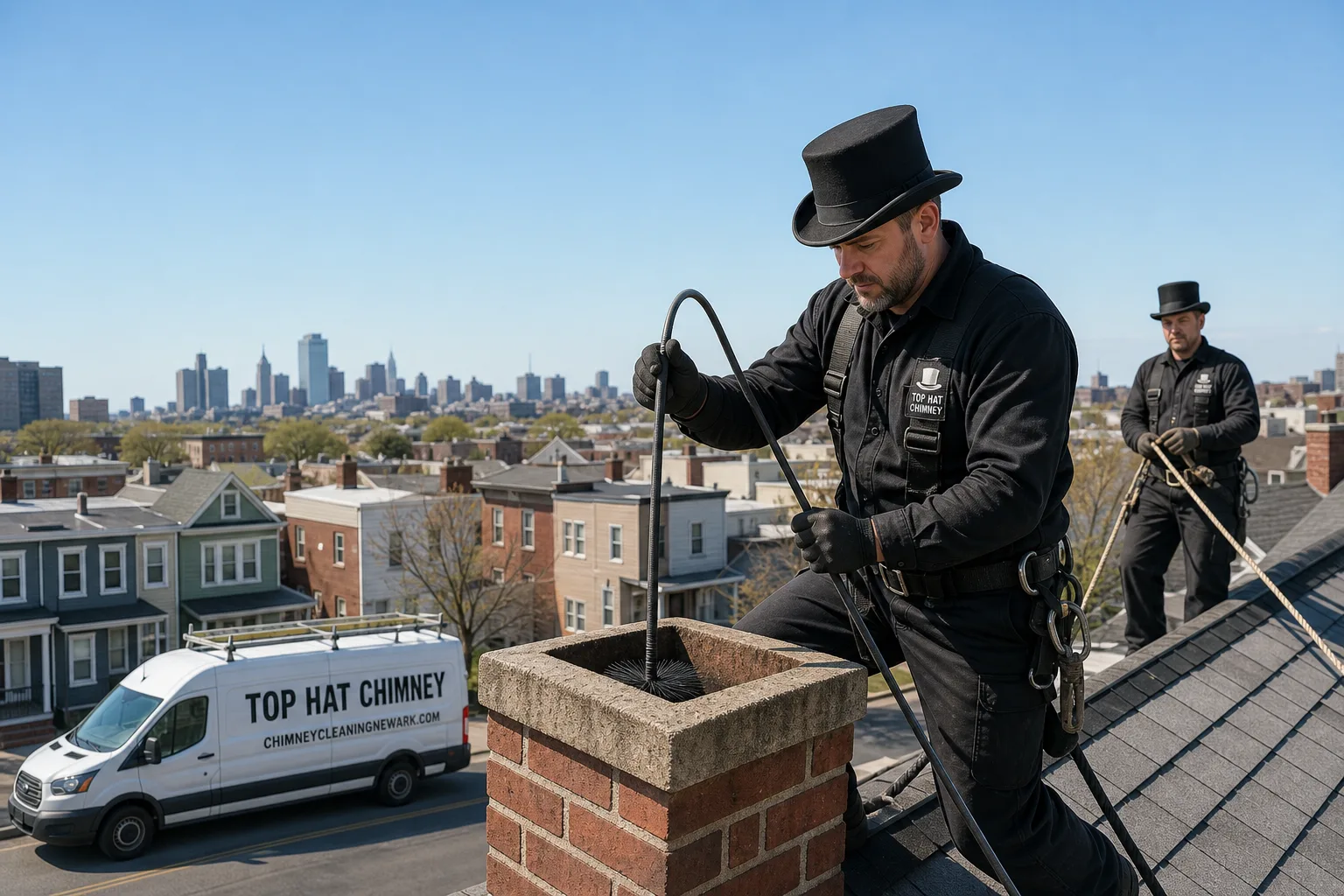
Level 1 sweep and inspection to the NFPA 211 annual standard - flue, crown, cap, and flashing checked and photographed
Chimney sweep logs do not sweep chimneys. They loosen some creosote - which then falls where a brush and vacuum still have to collect it.


 Before
 After
After Before
 After
After Before
 After
AfterFast, Reliable Chimney Cleaning & Sweep Across Newark
A chimney sweep in Newark typically costs $169 to $319 for a standard annual cleaning, and a Level 2 camera inspection usually adds $99 to $249 depending on flue count and access. Most sweeps in the city take 45 to 90 minutes once the crew arrives. Top Hat Chimney has cleaned and inspected stacks across Newark’s Ironbound, Clinton Hill, Weequahic, and Vailsburg neighborhoods since Wendell Pike founded the company in 1999. Call (848) 331-2638 and you’ll get Wendell or a member of his crew on the line, not a call center.
Newark’s chimneys are not like the ones in the suburbs. Most were built before 1940, many as multi-flue masonry stacks serving two- or three-family rowhouses. That changes how a cleaning should be done, how inspections should be read, and what actually needs fixing. We know the difference.
Why Top Hat Chimney Is Newark’s Preferred Chimney Cleaning & Sweep Company
Wendell started this company because he got tired of watching national outfits quote one price on the phone and a different one at the door. That does not happen here. The price you hear before we load a single brush is the price on the invoice. Every job in Newark gets the 90-Day Done Right Promise in writing. If the work is not right, one call brings the crew back at no charge. No fine print, no argument.
We answer the phone. Twenty-four hours a day, seven days a week, a live person picks up. Often it’s Wendell himself, sitting in the truck between Ironbound stops. The sweep who shows up at your Newark rowhouse is background-checked, uniformed, and works directly for Top Hat Chimney. Not a subcontractor pulled off an app. You’ll see the same face again if you call next year, and maybe run into him at the farmers market on Ferry Street.
Newark homeowners have a right to be skeptical. A lot of chimney companies send a tech who climbs on the roof, pokes around, and comes down with a clipboard full of scare-quotes. We do the opposite. Camera down the flue, live footage on a screen, and a plain-English verdict. If the flue needs nothing beyond a sweep, we tell you that. If it needs work, you’ll see exactly why with your own eyes before you spend a dime.
We also know the Chimney Cleaning & Sweep in Newark landscape well enough to know that Newark’s pre-war housing stock creates problems that a generic sweep from the exurbs will misread. Retrofitted flues, shared party walls, acid-etched clay liners. That’s our home turf. It’s what the camera gets pointed at first.
Our Chimney Cleaning & Sweep Services in Newark
Level 1 Inspection
A Level 1 inspection is what you get with a standard annual sweep. We visually examine the readily accessible portions of the chimney, the firebox, the damper, and the basic flue structure. In Newark, where most flues are old clay tile with decades of use behind them, a Level 1 is really a screening tool. It tells us whether the system looks sound and whether a deeper look makes sense. Most annual maintenance visits in Newark include a Level 1 as part of the service.
Level 2 Inspection
If you’re buying a home in the Ironbound or Forest Hill, or if your furnace was changed from oil to gas at some point over the last forty years, you need a Level 2. This puts a camera down the entire length of the flue and documents what’s actually in there. Cracked tiles, missing mortar joints, voids behind a shared party wall, glaze buildup, wrong-sized flue for a modern gas appliance. In Newark’s converted rowhouses, the Level 2 inspection is the single most important service we offer. Nothing gets recommended without that camera footage. If a company wants to sell you a $6,000 liner without a camera, send them away.
Creosote Removal
Creosote comes in three degrees. First-degree is the dusty soot that brushes off with a standard sweep. Second-degree is flaky and tar-like, and it takes more work. Third-degree is a hard, shiny glaze that bonds to the flue wall like glass. Newark sees a lot of third-degree because so many homes switched from coal to oil to gas over the decades, and each fuel change left a different combustion residue layered on top of the last. We remove what the brush can get and tell you honestly whether the rest needs chemical treatment, mechanical removal, or if the flue is beyond saving. Creosote removal in Newark typically runs $199 to $379 depending on degree of buildup and flue height.
Soot Removal
Soot removal is not the same as a creosote sweep. Soot is lighter, fluffier, and usually comes from oil burners, gas appliances, or occasional recreational fires. In Newark, where many basements still hold oil-to-gas converted furnaces venting into masonry chimneys, soot accumulation is a year-round issue, not just a winter one. A soot-clogged flue can push carbon monoxide back into a basement living space. Soot removal for a single-flue Newark rowhouse typically runs $149 to $249, same visit as the annual sweep.
Annual Sweep
Once a year, burn or no burn. Chimneys break in the off-season too. In Newark’s humid river-basin climate, spalling brick and deteriorating mortar happen whether the fireplace gets used or not. The annual sweep is the baseline service: brushes, rods, vacuum, and a full visual check. Our Chimney Cleaning & Sweep team handles hundreds of Newark rowhouses each year, and we’ll tell you plainly if the sweep is all you need or if the camera should go down next.
What happens when you call
- 1
A real person answersNo phone trees - you reach a local pro.
- 2
You get an upfront price rangeHonest numbers before anyone is dispatched.
- 3
A background-checked tech heads outLicensed & insured, dispatched right away.
- 4
You approve before work beginsNothing starts until you say go.
Trusted Brands We Service in Newark
When work is actually needed, we don’t use no-name parts. Top Hat Chimney installs and services liner systems from Copperfield and Olympia Chimney, plus repair products from Gelco. That matters in Newark, because the wrong liner spec on a converted gas flue is worse than no liner at all. We stock common repair components for the rowhouse flues we see most often, which means shorter turnaround when a cap gets blown off a Forest Hill stack or a clay tile section fails behind a Clinton Hill party wall. The parts are proven. The installation is Wendell’s crew. The guarantee is in writing.
Common Chimney Cleaning & Sweep Problems We See in Newark Homes
- Oversized flues from fuel conversions. A chimney built in 1915 for a coal furnace was sized to move a lot of hot air up a wide flue. A modern high-efficiency gas furnace produces cooler, denser exhaust. That exhaust condenses inside the oversized clay flue, creating acidic moisture that eats the liner from the inside out. We see this on nearly every pre-1940 Newark conversion.
- Cracked clay tiles in shared party-wall flues. In dense Ironbound blocks, chimneys are often built into the wall between two rowhouses. A crack in one unit’s flue tile can route carbon monoxide laterally into the neighboring apartment. That’s not a cleaning issue. It’s a liability issue and a life-safety issue, and it’s why Level 2 camera work matters so much in Newark specifically.
- Freeze-thaw spalling on exposed crowns. Newark sits between the Passaic River and Newark Bay, and the ambient humidity is high year-round. Water gets into the brick crown and mortar joints, freezes in January, thaws in March, and after a few decades of that cycle, the top two feet of the stack start shedding brick. North-facing stacks near the rivers get hit hardest.
- Third-degree creosote glaze from decades of mixed fuel use. Coal left one kind of residue, oil left sulfur condensate, wood fires left creosote. Layer them over a century and the flue walls end up coated with a hard, glassy glaze that a push-brush will not remove. We show homeowners the live camera feed before recommending anything beyond a standard sweep.
Pricing for Chimney Cleaning & Sweep in Newark, NJ
Call (848) 331-2638 for an exact quote. The estimate is free. The phone will be answered by a person.
We Also Serve Cities Near Newark
Top Hat Chimney works all over Essex County. We are in Irvington, Maplewood, East Orange, and Hillside regularly, and we’re familiar with the same pre-war housing stock, the same converted flues, and the same freeze-thaw crown damage we see in Newark. Homeowners in those towns get the same camera-first approach, the same written 90-Day Done Right Promise, and the same live-answer phone line. Scheduling works the same way no matter which side of the Passaic you’re on.
Serving Newark, NJ - Our Local Coverage Area
We’re based in the Newark area and know this community well. Use the map below to see our service coverage - if you’re nearby, we can almost certainly help.
FAQs - Chimney Cleaning & Sweep in Newark
Why do Newark rowhouses built before 1940 often have chimneys that are oversized for gas appliances?
They were built for coal. A 1920s coal-fired boiler generated a lot of hot exhaust, so the flue had to be wide to move it. Gas furnaces and boilers, especially modern high-efficiency units, produce cooler exhaust at lower volume. When that exhaust hits a cold, wide clay flue, the water vapor condenses and mixes with combustion byproducts to form acidic condensate. That acid eats clay tile from the inside out. So the flue isn’t just oversized. It’s actively being damaged every time the furnace runs. A camera inspection shows this in about ten minutes. Call (848) 331-2638 to schedule one and see the footage yourself.
Can a cracked flue tile in a shared party wall put neighbors at risk in Newark’s Ironbound?
Yes. This is one of the most dangerous situations we encounter in Newark. In dense rowhouse blocks, chimney stacks often run up through the shared wall between two homes. If one unit’s flue tile cracks, exhaust is supposed to move up and out. But a crack creates a path for carbon monoxide to move sideways through the wall into the adjacent unit’s living space. The people next door would have no idea anything is wrong, because the fire and the appliance are in your building. A Level 2 inspection with a camera is the only way to see this problem before it hurts someone. If you live in a rowhouse and haven’t had the flue camera-inspected in years, call (848) 331-2638.
How does third-degree creosote form in Newark chimneys that were converted from oil to gas?
The sequence matters. Coal left fine, hard particulates. Oil left sulfur-heavy soot that condensed on the flue walls. If the homeowner burned wood at any point in between, that added creosote. Over decades, with the flue surface roughened by acid etching, the creosote layers bake into a hard, shiny glaze that resists standard brushing. Newark’s high humidity adds moisture that helps the glazing process. Once third-degree creosote forms, no brush removes it. It takes mechanical removal or chemical treatment, and sometimes the liner is beyond saving. We’ll show you the live camera feed before anyone suggests anything, and you’ll see exactly what’s inside. For third-degree creosote removal in Newark, call (848) 331-2638 for a quote.
Why do Newark chimneys near the Passaic River spall so quickly?
Because of the humidity and the freeze-thaw cycle. Brick and mortar are porous. When the air is damp year-round, which it is near the Passaic and the Bay, those pores hold water. In January the water freezes and expands. In March it thaws. Every cycle pushes tiny cracks wider. After enough cycles, the brick face pops off in flakes and chunks, and the mortar joints crumble. That’s spalling. A crown that was solid ten years ago can be shedding brick by now. Repointing and crown repair are standard work for us in Newark, and we’ll quote it honestly, based on what the camera and the hammer actually show. Get a free estimate at (848) 331-2638.
Do I really need an annual chimney inspection if I don’t burn wood?
Yes, especially in Newark. If your furnace or water heater vents into the chimney, that flue is in use every single day, all year long. The acidic condensate we talked about does not take a summer break. A flue that is slowly being eaten by oil or gas exhaust is still deteriorating even if you never light a single log. Annual inspections catch cracked tiles before they become carbon monoxide pathways. In a city full of pre-war converted flues, skipping the inspection is a gamble with your family’s air supply. Call (848) 331-2638 to schedule one. It’s quicker and cheaper than waiting until something fails.
Call Top Hat Chimney for Chimney Cleaning & Sweep in Newark
If your Newark home has a chimney that’s been there since before World War II, it has a history. Maybe that history includes coal, oil, and gas. Maybe it includes a cracked tile behind a shared wall. Maybe it just needs a sweep and a clean bill of health. Either way, you want to know for sure, and you want to see the proof. That’s what we provide. Camera footage, straight answers, a fair price in writing, and a 90-Day Done Right Promise on every job. Wendell Pike has been running Top Hat Chimney since 1999, and he puts his name on the work. He’ll put it on yours too. Call (848) 331-2638 for a free estimate.
Written by Wendell Pike, Owner at Top Hat Chimney, serving Newark and Essex County since 1999.