
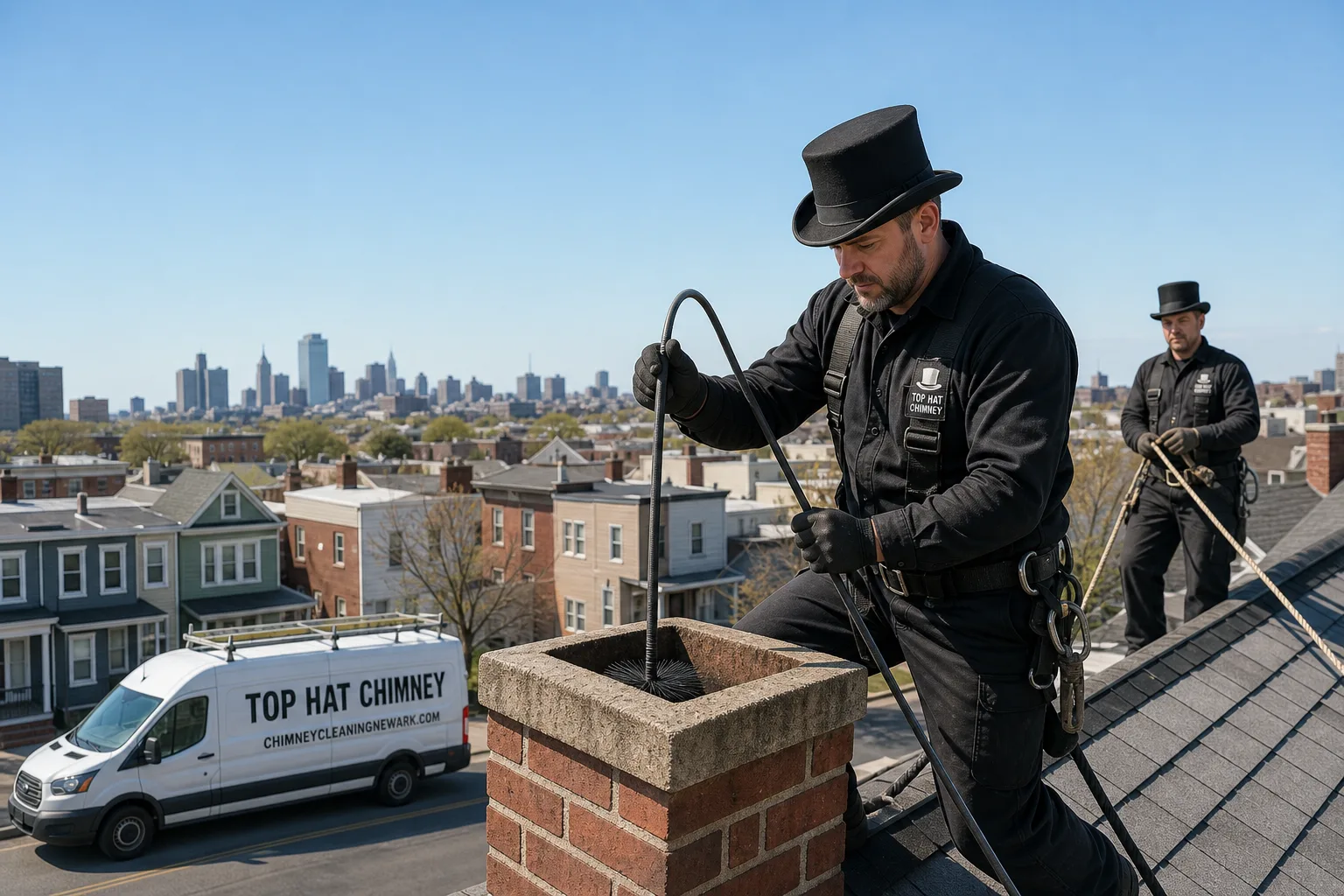
Level 1 sweep and inspection to the NFPA 211 annual standard - flue, crown, cap, and flashing checked and photographed
Chimney sweep logs do not sweep chimneys. They loosen some creosote - which then falls where a brush and vacuum still have to collect it.


 Before
 After
After Before
 After
After Before
 After
AfterFast, Reliable Chimney Repair Across Elizabeth
Chimney repair in Elizabeth, NJ usually means one of three things: water has found a way in, the original clay tile liner has started to spall after decades of mixed-fuel exhaust, or storm winds knocked something loose up top. Most repairs on Elizabeth row houses and two-family homes run between $350 and $1,800 depending on what the camera shows. Since 1999, Wendell Pike and his crew have worked these same brick rows off First Street, Magnolia Avenue, and the blocks around Warinanco Park, and they’ll give you a straight answer before any tool comes off the truck. Call (848) 331-2638 for a free estimate.
Why Top Hat Chimney Is Elizabeth’s Preferred Chimney Repair Company
Ask anyone on your street. Wendell has been inside more Elizabeth chimneys than he can count, and he’s the one who shows up at your door, not a rotating cast of subcontractors from two counties away. The business was founded in 1999, is locally owned and owner-operated, and carries a published license number Wendell puts on every invoice. No national chain, no call center. When you call (848) 331-2638, a live person answers, around the clock, and it may well be Wendell himself.
Elizabeth homeowners tell us the same story again and again: a big-name outfit quoted one number over the phone, then “discovered” another thousand dollars of work once the tech was on the roof. We don’t work that way. The price Wendell gives you up front is the price on the invoice, and every job carries the 90-Day Done Right Promise in writing. If something isn’t right, one call brings the crew back. We also offer a free second opinion on any competing written estimate, and seniors and veterans always save 10%.
Elizabeth’s dense brick housing stock is different from the split-levels in Cranford or the new builds out in Hillsborough. Shared chimney stacks serving multiple units, original clay tile liners that predate World War II, and decades of coal, oil, and gas exhaust all layered in the same flue. You want a sweep who knows what that looks like from the inside. That’s us.
Our Chimney Repair Services in Elizabeth
Most of what we do falls under the umbrella of Chimney Repair, but the specifics matter. Here are the four repairs we handle most often for Elizabeth homes.
Mortar Repointing
Elizabeth’s brick row houses took a beating this past winter. Coastal air off Newark Bay carries salt, and when that salt-saturated moisture soaks into mortar joints and freezes, the joints crack and crumble. Repointing replaces that deteriorated mortar with fresh material matched to the original, and it’s the difference between a chimney that sheds water and one that absorbs it like a sponge. On the bay-facing side of row houses, we see joints that need repointing years before the street side does.

Spalling Brick Repair
Spalling is what happens when water gets inside the brick face, freezes, and pops the surface off in thin flakes. Elizabeth homes near the port deal with this more than almost anywhere else in Union County because the moisture carries salt and sulfur particulates that accelerate the freeze-thaw damage. Left alone, spalled brick exposes the softer inner material, and the chimney starts losing structural mass. A cracked crown letting water into the smoke chamber will compound the problem fast.

Chimney Waterproofing
Waterproofing is the single most cost-effective repair we do on Elizabeth chimneys, especially on stacks facing Newark Bay or the Arthur Kill. We apply a vapor-permeable masonry sealant, usually Gelco or Olympia Chimney product, that stops liquid water from soaking into the brick while still letting the masonry breathe. Waterproofing alone won’t fix structural cracks, but combined with repointing and crown work, it can add decades to an older stack. It’s particularly useful in the low-lying Elizabethport area, where dampness is a year-round condition, not a seasonal one.

Flashing Repair
Flashing failure in Elizabeth shows up as a yellow-brown stain on a second-floor ceiling after a hard wind-driven rain. The metal where the chimney meets the roof line wears out, or it was never installed well in the first place, and water follows the gap straight down along the flue. We see it constantly on the older row houses. The fix usually involves removing the old flashing, fitting new step or counter flashing, and sealing it with the proper waterproof membrane. It’s a repair that looks small on paper and stops what would otherwise become a $4,000 ceiling and drywall problem.

What happens when you call
- 1
A real person answersNo phone trees - you reach a local pro.
- 2
You get an upfront price rangeHonest numbers before anyone is dispatched.
- 3
A background-checked tech heads outLicensed & insured, dispatched right away.
- 4
You approve before work beginsNothing starts until you say go.
Common Chimney Repair Problems We See in Elizabeth Homes
- Coal-to-gas liner spalling. Most of Elizabeth’s pre-WWII row houses burned coal or oil originally, then were converted to gas heat without ever relining the flue. The original clay tile liner was oversized for the coal exhaust, and now it’s massively oversized for the smaller, cooler gas exhaust. The gas cools and condenses inside the flue, creating acidic deposits that eat the clay tile from the inside out. This isn’t a problem newer towns see.
- Cracked crowns from coastal-industrial exposure. Salt spray off the Kill Van Kull and sulfur-heavy particulates from port and rail operations settle on chimney crowns year-round. Freeze-thaw cycles then work those contaminants into the crown’s surface, opening hairline cracks that widen every winter. We find crowns in Elizabethport that have lost a full half-inch of surface material to this combination.
- Displaced caps after nor’easters. Wind off the bay hits the exposed chimney stacks in the waterfront blocks hard. Caps get lifted or shifted, and then rain and nesting debris find their way straight down the flue. A displaced cap is one of the most common causes of draft reversal in Elizabeth homes, where a fire won’t start properly because air is being pushed back down the chimney.
- Flashing failures on the bay-facing slope. The wind-driven rain we get off Newark Bay hits rooflines at an angle that fresh-water towns don’t experience. Flashing that would be fine in Roselle Park or Union gets worked loose by the repeated pressure cycle of wind, rain, and drying. The first sign is almost always a ceiling stain in a top-floor bedroom or bathroom.
Pricing for Chimney Repair in Elizabeth, NJ
Here’s what chimney repair actually costs in Elizabeth, based on the work we’ve done across the city over the past few years. Mortar repointing on a typical row house chimney runs $35 to $55 per square foot of surface area, which usually works out to $450 to $900 for a standard exposed stack. Flashing repair runs $300 to $750 depending on whether it’s a partial or full replacement and how much of the surrounding roof line needs to be opened up. Chimney waterproofing runs $250 to $500 for a standard residential stack, including surface cleaning and two coats of sealant. Spalling brick repair runs anywhere from $500 for a few replacement bricks to $1,800 if large sections of the stack face need reconstruction. Full chimney rebuilding on Elizabeth row houses, including new crown, runs $2,500 to $5,000 depending on height and access. Every job starts with a camera inspection and a plain-English explanation of what we found, and every estimate is free. Call (848) 331-2638 to schedule yours.
Trusted Brands We Service in Elizabeth
We install and service products from Gelco, Olympia Chimney, Famco, and Copperfield, among others. Gelco’s waterproofing membranes hold up well against Elizabeth’s coastal salt exposure, and Olympia Chimney’s caps and dampers are built for exactly the kind of wind loads we see on the bay front. We stock common parts locally for Elizabeth customers, which means no three-week parts delays while your chimney sits open to the weather. When a cap needs replacing after a nor’easter, we usually have what we need on the truck.
One Thing We Know About Elizabeth That Others Miss
Here’s the Information Gain. In Elizabeth’s pre-WWII row houses, most clay flue liners were never relined after the coal-to-gas conversions. The homes were built when coal was the standard fuel, and the flues were sized for that: wide, tall clay tiles running up through the center of the house. When the furnace got swapped for gas, the exhaust became much cooler and much smaller in volume. That cool gas condenses inside the oversized flue, and the condensate is acidic. It eats at the clay tile joints, then the tile itself, creating cracks you can’t see from the ground. Every cleaning job on an Elizabeth row house should include a liner-condition assessment, because the flue was almost certainly not relined after the boiler swap. If you’ve lived in your home since before the conversion and never had the liner looked at, there’s a real chance the tiles are spalled and the chimney is pushing exhaust into the masonry cavity, not out the top.
On a shared chimney stack in Elizabethport off First Street, our crew found exactly this. A cracked crown and displaced cap after a nor’easter had let salt spray off the Kill Van Kull settle into the mortar joints for years, and water had already stained a second-floor ceiling. We replaced the cap, repointed the spalled brick, and applied a waterproofing membrane to the crown before the next freeze-thaw cycle could push the damage deeper. Then we ran the camera down the flue, found the original clay liner spalling from coal-to-gas condensation, and gave the homeowner a written report with still photos showing exactly what we saw. No work started until she saw the footage and approved the scope.
Storm Damage in Elizabeth: What to Check Before the First Fire
Elizabeth sits exposed. The chimneys in the low blocks near the bay, especially around Elizabethport, take the same salt-laden wind that batters the port machinery. After a nor’easter or a hard coastal storm, there are three things worth checking before you light the first fire of the season.
First, where the chimney meets the roof. Walk upstairs and look at the ceiling around the flue. A yellow-brown stain, or bubbling paint, means flashing has failed and wind-driven rain has been getting in. Second, the cap. If your chimney cap looks rusted, bent, or tilted, or if you can see daylight past it from the ground, it’s not doing its job. A displaced cap lets rain and nesting debris block the flue and can cause draft reversal the minute you light a fire. Third, the crown. Run a good set of eyes, or call us to get on the roof, and look for cracking along the mortar surface. A cracked crown lets water into the smoke chamber, which accelerates spalling in the clay tile liner behind it.
None of this is do-it-yourself work. The roof access on Elizabeth row houses is steep, the stacks are tall, and a fall from even a two-story roof is life-altering. Let Wendell and his crew handle it. They’re background-checked, uniformed, and they’ll show you the camera footage so you can see what they see.
We Also Serve Cities Near Elizabeth
If your home is in Hillside, Roselle Park, Linden, or Irvington, we can be there just as quickly. We do chimney repair in Elizabeth and all the surrounding communities, and the same owner, the same pricing, and the same 90-Day Done Right Promise apply no matter which side of the city line you’re on.
Serving Elizabeth, NJ - Our Local Coverage Area
We’re based in the Elizabeth area and know this community well. Use the map below to see our service coverage - if you’re nearby, we can almost certainly help.
FAQs - Chimney Repair in Elizabeth
White staining on the bay-facing side of your chimney is almost always efflorescence, which is salt and mineral residue left behind when water evaporates off the masonry. In Elizabeth, that water is salt-laden from Newark Bay and the Kill Van Kull, so it leaves more visible deposits than rainwater would in inland towns. The staining itself isn’t the main problem, but it tells you water is saturating the brick. The fix is usually repointing the mortar joints and applying a vapor-permeable waterproofing membrane like Gelco. Call (848) 331-2638 for a free inspection and we’ll tell you how far it’s gone.
Look for three things: a ceiling stain on the top floor near where the chimney passes through, a cap that appears tilted or displaced from the ground, and cracking or spalling on the exposed brick face you can see from the sidewalk. If you notice any of the three, don’t light a fire until the flue has been checked. Draft reversal from a blocked or damaged flue can push carbon monoxide back into the house. Wendell can run a camera down the flue, check the cap and crown from the roof, and give you a straight answer, usually the same week. The estimate is free.
Yes, and this is the single most important thing to understand about older Elizabeth homes. The original clay tile flue was sized for coal exhaust, which is hot and high-volume. Modern gas exhaust is cooler and low-volume, so it condenses inside the oversized flue and creates acidic deposits that slowly eat the clay tile. If your home was converted and the liner was never replaced or resized, it’s worth having a camera inspection. The cost to reline with a properly sized stainless liner is far less than the cost of repairing the smoke chamber after years of acidic spalling have had their way with it. Call (848) 331-2638 and we’ll show you the camera footage, every time, no exceptions.
Homes in the blocks adjacent to the port sit in a constant bath of salt spray, diesel exhaust particulates, and sulfur compounds from rail and ship operations. Standard galvanized caps rust through in five to eight years in that environment, where the same cap would last twenty years in Roselle or Cranford. We replace most port-area caps with heavier-gauge stainless steel from Olympia Chimney or Famco, which holds up far better. If your neighbor’s cap looks rusted, yours is probably not far behind.
Yes. A cracked crown lets water into the smoke chamber, and in a shared chimney stack, that water doesn’t necessarily stay in one unit’s flue. It can travel laterally through the masonry and show up as a stain in the ceiling of a neighboring unit that has never burned a single log. This is one of the reasons shared-stack repair in Elizabeth row houses needs a camera inspection before any repair plan is drawn up. You need to know where the water is entering, not just where it’s showing up. Call (848) 331-2638 for a free estimate and we’ll show you the footage.
Written by Wendell Pike, Owner at Top Hat Chimney, serving Elizabeth since 1999.